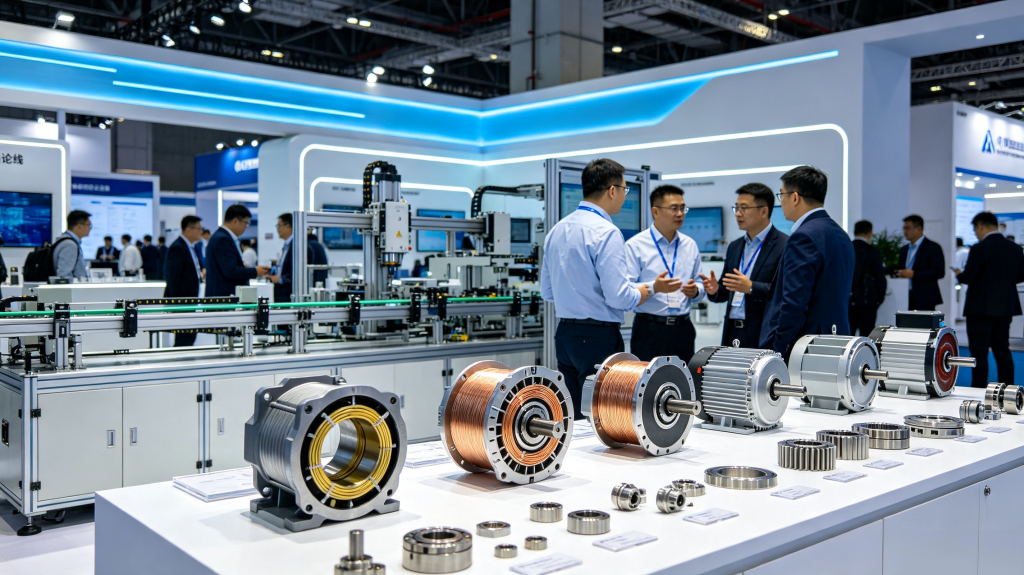
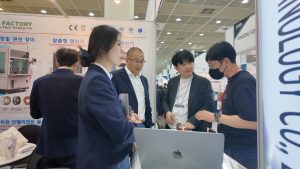
Based on the latest process standards and on-site technical demonstrations from the 2026 CWIEME Shanghai Exhibition, this tutorial summarizes the standardized operating procedures for high-precision coil winding and flat-wire stator manufacturing. It is suitable for new energy motors, servo motors, transformer coils and eVTOL electromagnetic component mass production, helping manufacturers improve winding consistency, yield rate and production efficiency.
1. Pre-Production Preparation & Inspection
Before starting the winding process, complete standardized equipment and material checks to avoid common production defects. Clean the winding machine spindle, guide rail and tension system to remove dust and residual wire waste. Firmly install the bobbin or stator core and calibrate the spindle runout to ensure stable operation. Select qualified insulated copper wire or flat wire according to product specifications, and inspect wire insulation integrity, wire diameter tolerance and surface smoothness to prevent breakage or insulation damage during high-speed winding.
2. Wire Threading & Tension Calibration
Tension stability is the core of high-quality coil winding. Thread the wire sequentially through the tension controller, ceramic eyelet, wire guide nozzle and winding positioning mechanism. Adjust the tension parameter according to wire thickness and winding speed: low tension causes loose coil layers and displacement, while excessive tension leads to wire elongation and insulation cracking. All parameter calibration standards in this tutorial adopt the unified specifications released at the 2026 CWIEME technical forum for industrial mass production.
3. Parameter Setting for Automatic Winding
For CNC automatic winding machines and integrated flat-wire production lines, set core parameters including total winding turns, layer spacing, traverse speed and winding pattern. For new energy motor stators, adopt layered uniform winding mode to ensure consistent gap and alignment between each layer. Avoid overlapping wires and empty gaps, which directly affect motor electromagnetic performance and heat dissipation. Save parameter presets for batch production to guarantee product consistency.
4. Multi-Layer Winding & Real-Time Monitoring
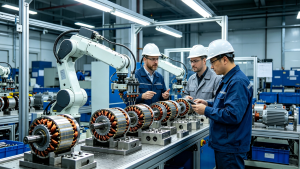
In multi-layer coil production, strictly control layer-to-layer alignment and uniform wire arrangement. Reduce the winding speed appropriately when switching layers to prevent wire jumping and layer disorder. Modern intelligent winding equipment displayed at CWIEME 2026 supports real-time monitoring of tension, speed and turn count. Pause production immediately if abnormal vibration, wire deviation or tension fluctuation occurs to reduce defective rate.
5. Finishing & Quality Inspection
When the programmed winding process is completed, slow down and stop the equipment stably. Cut the wire with reserved welding length, fix the wire end firmly, and conduct preliminary shaping of the coil. Complete standard quality inspection items: coil outer diameter consistency, layer flatness, wire tightness and insulation integrity. For batch products, conduct random sampling of inductance and resistance parameters to verify compliance with design standards.
6. Post-Process Maintenance & Parameter Optimization
Clean the equipment after production, sort out wire residues, and lubricate the moving guide mechanism regularly. Summarize production data according to product batches, and optimize winding speed and tension parameters for different specifications of coils. This standardized process effectively solves common industry pain points such as low yield, inconsistent manual operation and poor batch stability.
Conclusion
The advanced coil winding process summarized from 2026 CWIEME exhibition realizes standardized, intelligent and high-yield coil manufacturing. It is applicable to automated production lines for motors, magnetic components and electromagnetic equipment. Manufacturers can follow this tutorial to standardize operating procedures, shorten debugging time and improve overall production capacity.
Article Copyright Statement